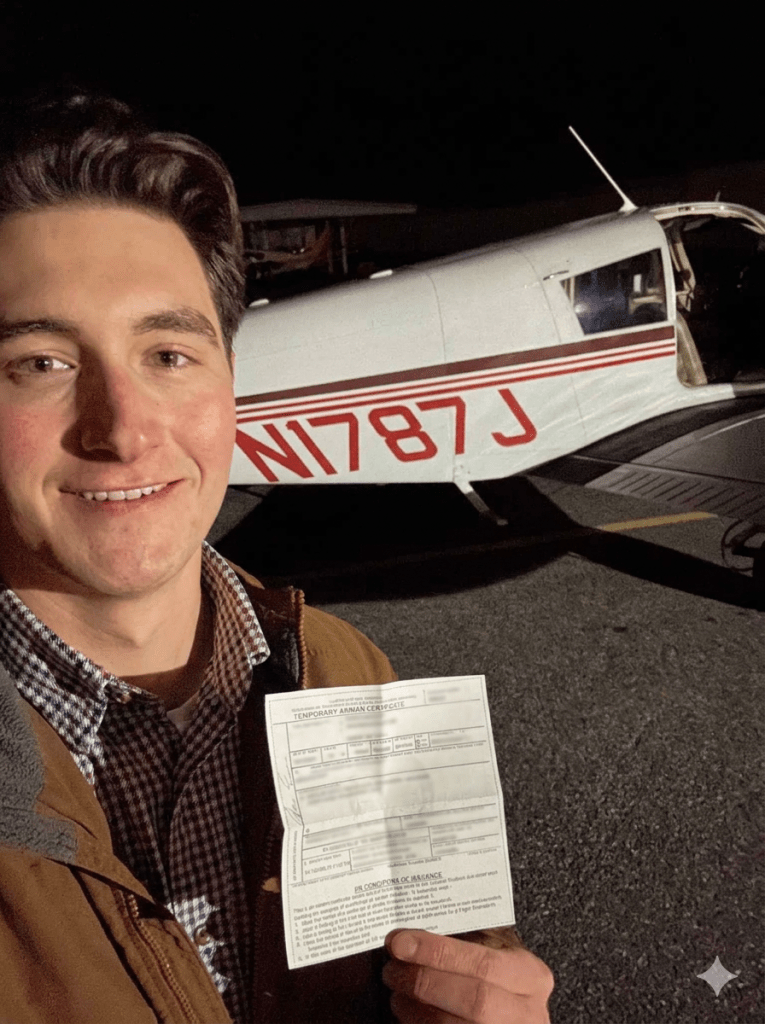
For many pilots, the transition from flying by sight to flying solely by reference to instruments is the most significant milestone in their aviation career. It is the moment the horizon disappears, and the cockpit becomes the entire world. For Austin, who recently earned his Instrument Rating this journey wasn’t just about learning new gauges; it was about a fundamental shift in mindset, discipline, and respect for the sky.
The jump from Visual Flight Rules (VFR) to Instrument Flight Rules (IFR) is often a wake-up call. During his training with his instructor, Brad, Austin quickly realized that the margin for error shrinks significantly when you lose the ground as a reference.
“If you’re not paying attention, the plane can get away from you a little bit quicker,” Austin notes. While “foggles” are used in training to simulate clouds, Austin found that there is no substitute for the real thing. Unlike training foggles, where a sneaky glance out the side window might provide a hint of the horizon, “actual” clouds offer no such luxury. This transition required him to master the art of multitasking, developing the ability to scan his instruments constantly without getting “hyper-focused” on any single piece of data.
Instrument flying is a game of inches and seconds. Austin found that the most challenging aspect was the final approach phase specifically, the delicate dance of matching a descent rate to a glide slope. The key to success wasn’t just steady hands, but mental math and preparation.
Austin’s breakthrough came when he learned to have the airplane in the proper “approach attitude” well before reaching the final approach fix. By staying hyper-attentive and calculating his needs in advance, the complex maneuvers began to “click,” turning a chaotic workload into a disciplined flow.
In the IFR environment, the radio is constant, the avionics are complex, and the weather is ever-changing. Austin’s secret to managing the high workload is a simple mantra: know what comes next.
“Understand the patterns of each flight so you have a few extra seconds to orient yourself for the next couple of minutes.”
He emphasizes utilizing “downtime” effectively. If you are 30 miles out, you should already be looking at the weather. If you have a few miles before a fix, that is the time to brief the approach and review minimums. By staying ahead of the airplane, Austin ensures he is never reacting to the flight, but rather leading it.
Even the best preparation can’t account for every variable. During his practical exam, Austin faced a scenario no textbook could have predicted: a loud rattling outside the cockpit during takeoff.
In a moment of high-pressure decision-making, Austin and his examiner shared a look, and Austin made the “pilot-in-command” choice to land immediately and investigate. The culprit? The tail of the examiner’s seatbelt had caught in the door. While it was a minor mechanical issue, the “curveball” proved Austin’s readiness to prioritize safety over the desire to complete the mission—a hallmark of a professional pilot.
Earning the rating has fundamentally changed how Austin views his time in the cockpit, even on sunny VFR days. He feels like a more competent pilot because of his deeper understanding of Air Traffic Control (ATC) capabilities and meteorology.
However, with that increased capability comes increased humility. Austin is vocal about the “difference between living and dying” when it comes to instrument proficiency. He warns against the danger of hopping into the clouds without being proficient, especially with passengers on board. For Austin, the rating isn’t a trophy; it’s a license to continue learning and maintaining a high standard of excellence.
With his instrument rating secured, Austin’s eyes are on the future—and on giving back to the aviation community. His immediate goal is to get his own aircraft “online” at Hewison Aviation.
“I would love to see students get their Private and Instrument ratings in my plane,” Austin says. As he works toward his Commercial Pilot Certificate, he is doing so with a new level of precision and a deep respect for the clouds he now calls home.
